
TL;DR
- NGINX2Root encompasses five nginx vulnerabilities and one Linux kernel vulnerability that, under certain conditions, allow an attacker to progress from unauthenticated remote code execution (RCE) to root access.
- CVE-2026-123007 (CVSS 4.0: 9.2) is the vulnerability examined in this article. It affects official nginx versions since 1.9.5 when HTTP/2 is enabled.
- Exploitation remains complex: the published PoC requires approximately 128 GB of traffic, high bandwidth, a specific system environment, and direct access to the vulnerable HTTP/2 processing mechanism.
- 64.39% of nginx services observed by ONYPHE do not disclose any version information. Across all services examined since November 18, 34.85% advertise an older version, and only 0.75% advertise an officially patched version.
- The first patched versions are gradually appearing in ONYPHE data: at noon on November 20, 4.76% of services with an identifiable version advertised a patched version within the hourly sample.
- HTTP/2 was detected on approximately 40% of the 10,000 targets tested. However, neither an outdated version nor the presence of HTTP/2 is sufficient to confirm that a server is actually exploitable.
Introduction
On November 18, 2026, the disclosure of NGINX2Root revealed several vulnerabilities affecting nginx, one of the most widely used web servers on the Internet. Under specific conditions, some of these vulnerabilities allow unauthenticated remote code execution, with the possibility of subsequently escalating privileges to root.
Among them, CVE-2026-123007 is of particular interest: present since HTTP/2 support was introduced in nginx in 2015, it potentially affects a very large number of exposed servers.
However, there are several important distinctions between a vulnerable version, an Internet-accessible service, and a vulnerability that can actually be exploited.
In this article, we examine how this vulnerability works and its exploitation constraints before using ONYPHE data to assess the exposure of nginx servers on the Internet, a few days after the patches were released.
Background: the evolution of the HTTP protocol
Since its introduction in the early 1990s, the HTTP (Hypertext Transfer Protocol) protocol has undergone several changes primarily aimed at improving the performance of communications between clients and servers.
Early versions, from HTTP/0.9 to HTTP/1.1, progressively introduced HTTP methods, headers, status codes, and persistent connections (Keep-Alive), allowing the same TCP connection to be reused for multiple requests.
HTTP/2: a new architecture and a new attack surface
Introduced in 2015, HTTP/2 represents a significant evolution of the protocol. Unlike HTTP/1.1, which relies on text-based messages, HTTP/2 uses a binary format in which communications are divided into frames.
It also introduces multiplexing, allowing multiple request and response streams to be carried simultaneously over a single TCP connection. Frames from different streams can therefore be interleaved, improving communication efficiency.
To regulate the amount of data transmitted, HTTP/2 also uses a flow control mechanism. This mechanism relies on transmission windows that determine how much data a server can send, both for each individual stream and for the connection as a whole.
These new mechanisms improve performance but also introduce new attack surfaces, particularly in the management of streams and flow control windows.
It is precisely within the latter mechanism that CVE-2026-123007, one of the vulnerabilities grouped under the name NGINX2Root and examined in this article, is located.
HTTP/3: the transition to QUIC
Standardized in 2022, HTTP/3 continues this evolution by replacing TCP with QUIC, a UDP-based transport protocol that integrates TLS 1.3 encryption. This architecture notably improves packet loss handling by allowing other streams to continue progressing independently.
NGINX2Root: five nginx vulnerabilities and privilege escalation to root
On November 18, 2026, NGINX released two new versions, 1.31.9 (mainline) and 1.30.7 (stable), addressing ten security vulnerabilities.
Five of these vulnerabilities were grouped under the name NGINX2Root by the Xint research team, which discovered them.
These vulnerabilities constitute different attack vectors that can lead to remote code execution (RCE). In the scenario presented by Xint, an additional Linux kernel vulnerability affecting the SCTP subsystem subsequently allows the privileges of the NGINX process to be escalated to root.
However, the five NGINX vulnerabilities have different prerequisites:
| CVE | NGINX title | NGINX severity | Vulnerable versions | Prerequisites |
|---|---|---|---|---|
| CVE-2026-123007 | Memory corruption in HTTP/2 flow control | major | 1.9.5 – 1.31.8 | HTTP/2 enabled |
| CVE-2026-123633 | Use-after-free in HTTP/2 | medium | 1.19.7 – 1.31.8 | HTTP/2 + upstream, worker_connections exhausted |
| CVE-2026-123634 | Use-after-free in the DNS resolver | medium | 0.6.18 – 1.31.8 | resolver + request-derived proxy_pass |
| CVE-2026-121810 | Use-after-free in HTTP/3 | medium | 1.25.0 – 1.31.8 | HTTP/3 + upstream, worker_connections exhausted |
| CVE-2026-113425 | Use-after-free in the mail proxy module | major | 0.5.33 – 1.31.8 | Mail proxy module, auth_http |
Sources: official NGINX security advisories and published technical analyses. Exact exploitation conditions depend on the configuration.
In this article, we focus on CVE-2026-123007, which affects official NGINX versions since the introduction of HTTP/2 support in 2015, when this protocol is enabled.
Rapid7 notably published a public PoC for this vulnerability, demonstrating unauthenticated remote code execution on an nginx 1.31.8 installation.
CVE-2026-123007: a flaw in HTTP/2 flow control
As previously discussed, HTTP/2 allows multiple streams to be multiplexed to regulate the amount of data a server can send to the client. This mechanism relies on a credit, expressed in bytes, which decreases as data is sent and can be increased by the client using WINDOW_UPDATE frames.
Nginx maintains two separate counters:
stream->send_window: a per-stream counter stored as a signed integer (ssize_t).h2c->send_window: a counter shared across the entire HTTP/2 connection, stored as an unsigned integer (size_t).
The protocol imposes a maximum limit of 2³¹ − 1 bytes on these windows. However, under certain conditions, NGINX can exceed this limit without checking it, paving the way for an integer underflow and subsequent memory corruption.
In NGINX, this limit is defined by the NGX_HTTP_V2_MAX_WINDOW constant.
How does the vulnerability work?
The analysis published by Rapid7 details an exploitation chain consisting of several steps.
1. Keeping data pending transmission
The attacker deliberately slows down the reading of HTTP/2 responses. DATA frames consequently remain queued on the NGINX side, while their credit has already been deducted from the flow control windows.
2. Increasing the connection window to its maximum value
Using WINDOW_UPDATE frames, the attacker increases the h2c->send_window connection window to its maximum permitted value of 2³¹ − 1.
3. Triggering stream closure without closing the connection
The attacker modifies the setting that defines the initial credit allocated to streams, causing some streams to exceed their limit.
According to RFC 9113, NGINX should then close the connection with a FLOW_CONTROL_ERROR error. However, vulnerable versions only close the affected streams using RST_STREAM, while keeping the connection active.
4. Exceeding the connection counter limit
During the cleanup of closed streams, NGINX restores the credit reserved for canceled DATA frames to the connection window, without checking whether the counter remains below 2³¹ − 1.
The connection window then exceeds the limit imposed by HTTP/2 without immediately triggering an arithmetic overflow.
5. Triggering an integer underflow
When processing a new WINDOW_UPDATE frame, NGINX checks whether the requested increase complies with the permitted limit:
window > NGX_HTTP_V2_MAX_WINDOW - h2c->send_window
However, since h2c->send_window
This integer underflow renders the check ineffective, allowing the attacker to artificially increase the connection window well beyond the limits defined by the protocol.
From integer underflow to code execution
The underflow does not directly enable code execution. However, it makes it possible for abnormally large values to be used when processing HTTP/2 responses.
Conversions between signed and unsigned integers can then turn these values into incorrect copy sizes passed to the memcpy() function. On certain implementations, this results in out-of-bounds memory accesses (out-of-bounds read/write).
Rapid7 demonstrated that this memory corruption could lead to unauthenticated remote code execution (RCE), with the privileges of the NGINX worker process.
Obtaining root privileges subsequently requires exploiting a separate Linux kernel vulnerability (a zero-day without a CVE identifier, unpatched at the time of publication).
A critical vulnerability, but difficult to exploit in practice
CVE-2026-123007 has a CVSS 4.0 score of 9.2/10 (Critical). Despite the possibility of unauthenticated remote code execution, exploitation remains complex and depends on several conditions.
The PoC published by Rapid7 highlights three major constraints:
- A large volume of traffic and high bandwidth. The PoC requires approximately 119 GiB of HTTP/2 traffic (nearly 128 GB) to artificially increase the counter to the values required for exploitation. Since NGINX limits the lifetime of an HTTP/2 connection to approximately one hour by default, a throughput of at least 300 Mbit/s towards the target is required to reproduce this method within the allotted time.
- A specific system environment. The published RCE technique relies on the behavior of an optimized implementation of
memcpy()(EVEX/YMM) on the x86-64 architecture. Its effectiveness therefore depends, in particular, on the processor and the version of the glibc library in use. Other exploitation methods may exist, but they are not demonstrated in this PoC. - Direct access to the vulnerable HTTP/2 processing mechanism. When the HTTP/2 connection is terminated by a CDN, reverse proxy, or load balancer before reaching NGINX, the frames used by the attacker are generally not forwarded as-is. This configuration may therefore prevent the described exploitation, even if the origin server runs a vulnerable version.
An NGINX server exposed over HTTP/2 is therefore not necessarily exploitable. The software version provides an initial indicator, but the network architecture and system characteristics also play a decisive role.
HTTP/2 exposure does not necessarily imply an exploitable vulnerability
The presence of an nginx service accessible over HTTP/2 is not sufficient to establish that it is vulnerable to CVE-2026-123007, let alone that RCE is achievable. Applied patches, network architecture, and the characteristics of the underlying system must also be taken into account.
The official patched versions, 1.30.7 and 1.31.9, have been available since November 18, 2026. Disabling HTTP/2 also reduces exposure to CVE-2026-123007, without addressing the other NGINX2Root vulnerabilities.
It is this distinction between an exposed service, a potentially vulnerable version, and actual exploitability that we will now examine using ONYPHE data.
Exposure surface
Millions of nginx servers exposed on the Internet
To assess exposure to NGINX2Root, we began by identifying nginx services accessible from the Internet using data collected by ONYPHE.
Over the past seven days, ONYPHE scanners have identified several million nginx services distributed worldwide. While ports 80 (HTTP) and 443 (HTTPS) naturally account for the majority of observations, nginx is also present on numerous alternative ports, including 8080 and 8443.
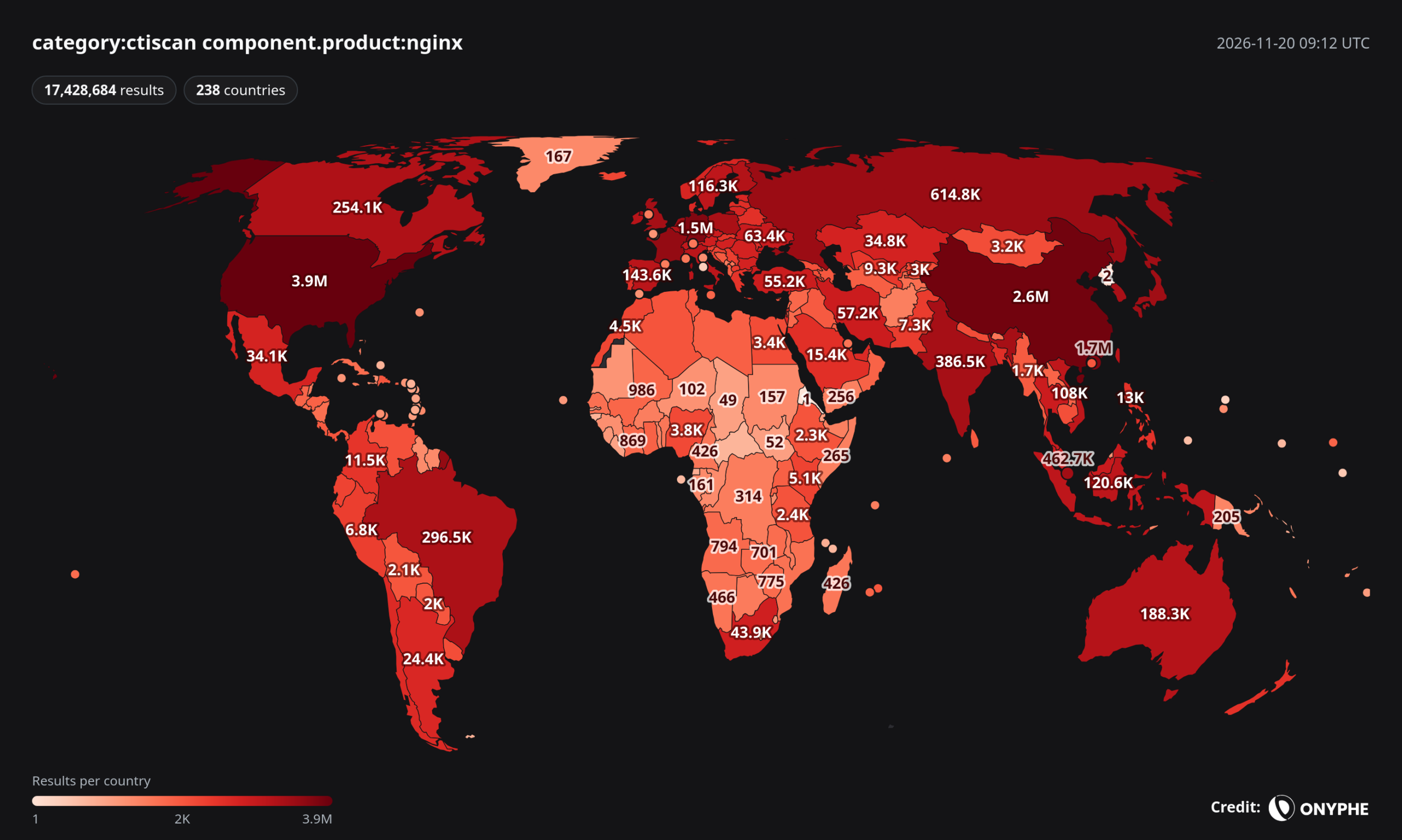
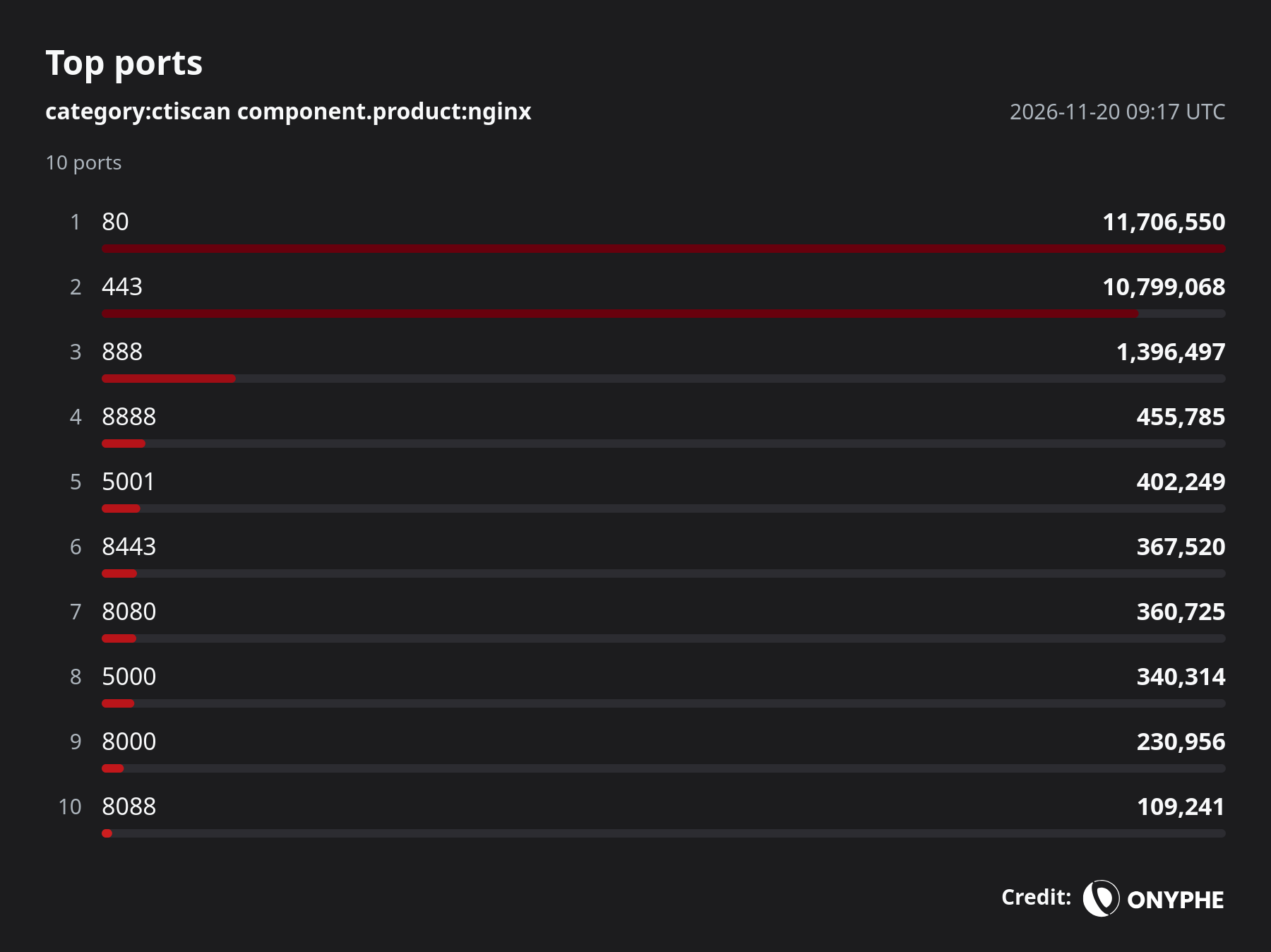
Figure: Geographical distribution of exposed nginx services and top 10 ports observed over the past seven days. Source: ONYPHE VeryScaryMap.
This initial mapping provides an overview of the extent of nginx exposure on the Internet. However, it does not establish how many of these services are actually vulnerable to CVE-2026-123007.
Which nginx versions are still exposed?
To refine this analysis, we examined the nginx versions detected by ONYPHE.
The results highlight an initial challenge: 64.39% of the observed nginx services do not disclose any version number. Among the remaining services, 34.85% advertise a version predating the November 18, 2026 patches, while only 0.75% advertise one of the two patched versions, 1.30.7 or 1.31.9.
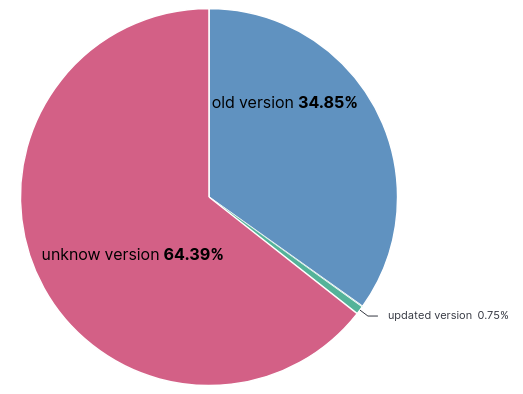
Figure: Distribution of nginx services by advertised version since November 18, 2026, excluding honeypots. Source: ONYPHE.
These results must nevertheless be interpreted with caution. An outdated version does not necessarily mean that the server is vulnerable, as some Linux distributions incorporate security patches without changing the advertised version number. Conversely, the absence of version information makes it impossible to determine whether the server has been patched.
To observe the initial deployment of the patches, we subsequently tracked the appearance of versions 1.30.7 and 1.31.9 in ONYPHE data on an hourly basis, excluding honeypots.
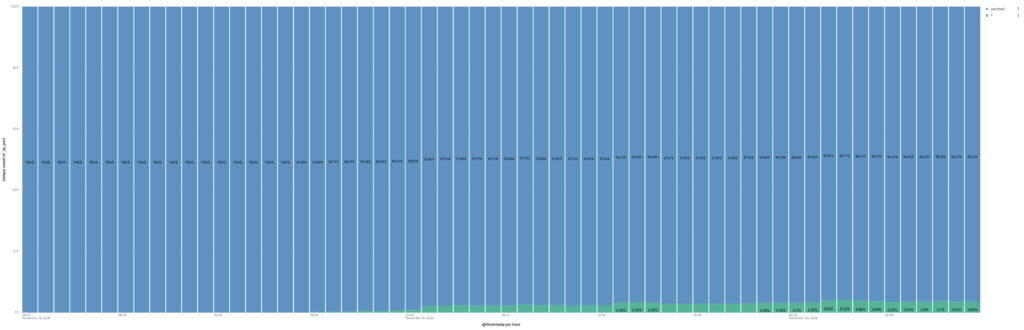
Figure: Hourly evolution of the proportion of nginx services advertising versions 1.30.7 or 1.31.9, from November 18 to 20, 2026. Source: ONYPHE.
The first patched versions appeared in our observations late on November 18. The proportion of services advertising a patched version, among those with an identifiable version, reached 4.76% at noon on November 20. This hourly measurement should not be directly compared with the overall distribution presented previously, as the observation scopes differ.
It should nevertheless be noted that each data point in the chart corresponds to services observed during a given hour. Rather than tracking the same servers over time, the chart represents successive samples whose composition may vary. The observed fluctuations therefore do not necessarily reflect the installation or removal of patches.
As of that date, patched versions remain a minority among services for which we can identify the version. However, this proportion does not directly represent the actual update rate across the nginx installed base.
HTTP/2: what is the actual exposure?
As previously discussed, the presence of a potentially vulnerable nginx version is not sufficient to establish exposure to CVE-2026-123007. The server must also accept HTTP/2 connections.
According to ONYPHE data, 55.36% of observed nginx services use TLS. However, this proportion includes numerous services identified as honeypots.
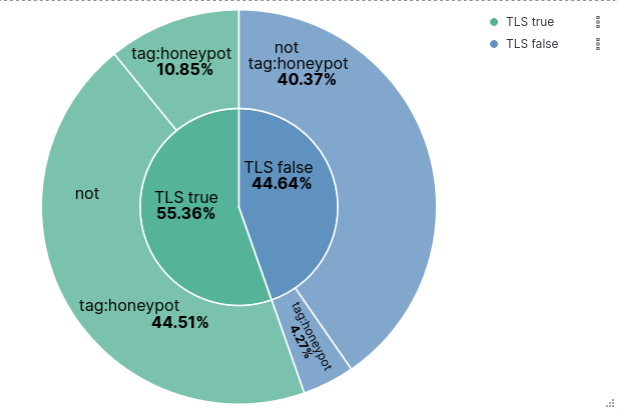
Figure: Distribution of exposed nginx services according to the presence of TLS and their classification as honeypots. Source: ONYPHE.
To further investigate this exposure, we sought to identify servers accepting HTTP/2.
The tests were conducted on a sample of 10,000 nginx targets on port 443, using TLS and not carrying the honeypot tag.
These initial measurements suggest that 41.2% of the targets use HTTP/2. However, these results cannot be generalized to all nginx services exposed on the Internet, as our sample is limited and specific.
Finally, HTTP/2 support is not sufficient to confirm the exploitability of CVE-2026-123007. The actual deployed version, applied patches, and the potential presence of an intermediary terminating HTTP/2 connections must also be taken into account.
Conclusion
NGINX2Root illustrates how a vulnerability present in nginx for more than ten years can pave the way for remote code execution, or even full system compromise when combined with privilege escalation.
Although exploiting CVE-2026-123007 remains complex, the presence of nginx across millions of Internet-exposed services makes it a particularly relevant vulnerability to monitor.
ONYPHE data nevertheless highlights the limitations of an analysis relying solely on banners and software versions. Nearly two-thirds of observed services do not disclose any version information, while the first patched versions are only beginning to appear in our scans.
Our additional tests also show that slightly more than 40% of the 10,000 nginx HTTPS targets examined accept HTTP/2, one of the conditions required to exploit CVE-2026-123007.
These results provide a better characterization of the exposure surface but do not allow us to determine precisely how many servers are actually exploitable. The presence of backported patches, server configuration, and network architecture remain factors that are difficult to assess from the Internet.
Updating nginx to a patched version therefore remains the primary mitigation measure, even when exploitation constraints or the presence of a network intermediary appear to reduce the risk.